
German for Beginners: How I Learned to Stop Fighting the Grammar
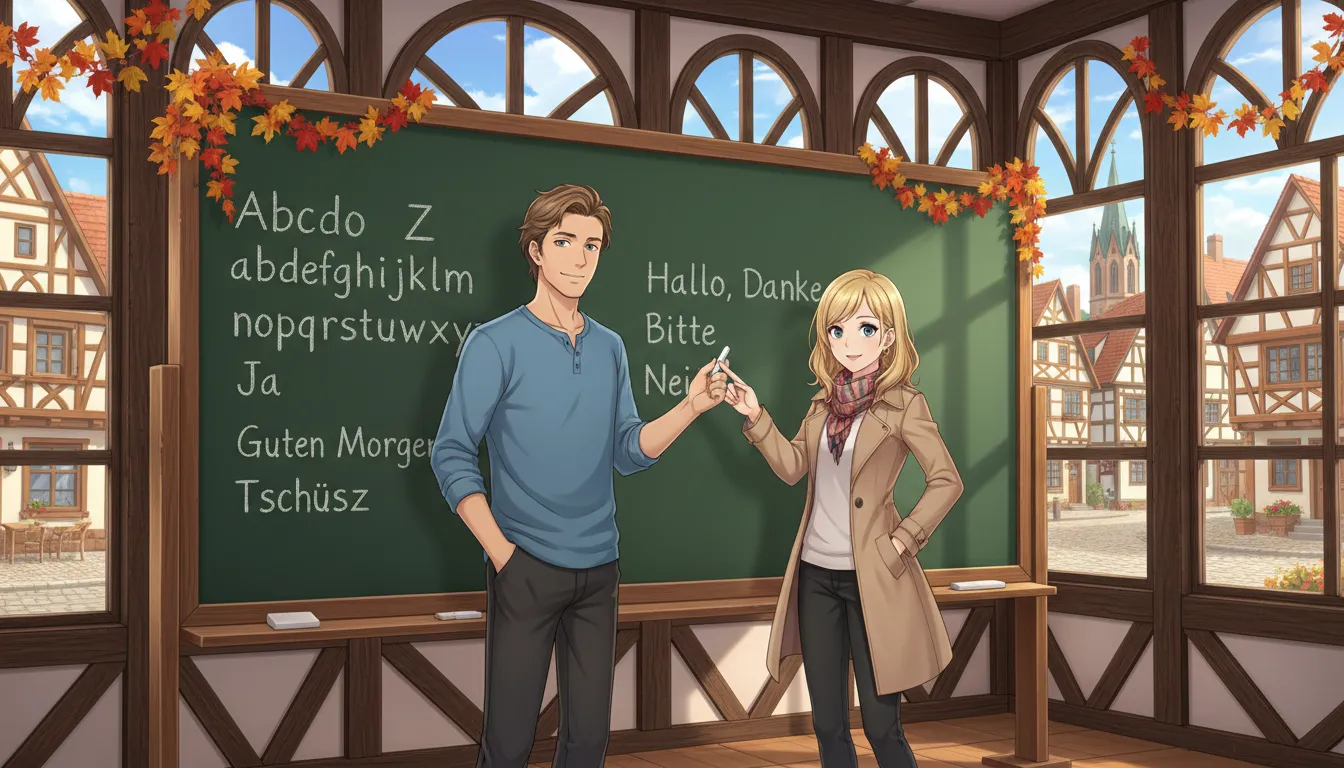
I stared at the declension table for ten minutes straight. Nominative. Accusative. Dative. Genitive. Each with different endings for masculine, feminine, neuter, and plural. Sixteen combinations just to say "the."
That was week two of learning German. I nearly quit right there.
Three months later, I'm having actual conversations. Not fluent, but functional. I can order food, ask for directions, talk about my work, complain about the weather. The grammar that terrified me? It's starting to feel like second nature.
If you're thinking about learning German as a beginner, this post is everything I wish someone had told me before I started. Not a textbook overview - just the real experience, the mistakes I made, and what actually worked.
Why I Chose German
I'm a tech founder. My company works with partners across Europe, and German kept coming up. Germany, Austria, Switzerland - collectively they represent the largest economy in Europe. Every business conversation eventually circled back to German-speaking markets.
But it wasn't just business pragmatism. I've always been fascinated by German engineering. The precision, the attention to detail, the way German cars and tools and machines just work. I wanted to understand the language behind that culture.
Plus, I'd heard German was one of the easier languages for English speakers. We'll come back to that claim later.
The Case System Shock
Here's what they don't warn you about: German has four grammatical cases, and they change the articles and adjectives depending on the noun's role in the sentence.
The dog (nominative - subject) becomes "der Hund." I see the dog (accusative - direct object) becomes "den Hund." I give the dog food (dative - indirect object) becomes "dem Hund." The dog's tail (genitive - possession) becomes "des Hundes."
Coming from English, this felt like learning a different type of math. English has cases too, technically, but we mainly show them through word order. German makes you memorize tables.
My initial panic was real. I spent three days just staring at case charts, trying to force them into my brain. Nothing stuck. I was drilling flash cards and getting more confused, not less.
What calmed me down: I stopped trying to memorize the tables and started reading simple sentences. Children's books, basic news articles, beginner dialogues. I highlighted the articles in different colors - blue for nominative, red for accusative, green for dative, yellow for genitive. Seeing them in context, over and over, made the patterns click in a way that tables never did.
The breakthrough moment was realizing that 80% of the time, you're using nominative or accusative. Dative comes up regularly but in predictable contexts (after certain prepositions, with certain verbs). Genitive is rare in spoken German - people use "von + dative" instead. Suddenly four cases became "learn two well, get comfortable with one, don't stress about the fourth."
Three Genders, No Logic
German nouns have three genders: masculine (der), feminine (die), and neuter (das). There are some patterns - nouns ending in -ung are usually feminine, nouns ending in -chen are neuter - but mostly, it's random.
Girl? Mädchen. Neuter. Because it ends in -chen.
Table? Tisch. Masculine. Because... reasons.
Spoon? Löffel. Masculine. Fork? Gabel. Feminine. Knife? Messer. Neuter. Even your silverware can't agree on gender.
This drove me crazy for weeks. I kept using "die Tisch" (feminine table) instead of "der Tisch" (masculine table), and native speakers would gently correct me. Every. Single. Time.
My coping strategy: I stopped trying to find logic and started using memory tricks. I visualized objects with exaggerated masculine/feminine/neuter characteristics. Der Tisch became a burly wooden table with a mustache. Die Gabel became a fork wearing a dress. Das Messer became a robot knife (neuter felt robotic to me). Ridiculous? Absolutely. Did it work? Surprisingly, yes.
The other trick: I learned the article with the noun, always. Never just "Tisch" - always "der Tisch." Never just "Gabel" - always "die Gabel." If you learn them together from day one, you wire them as a unit in your brain.
Compound Words Are Amazing
Once you get past the gender chaos, German gives you something incredible: compound words. German builds vocabulary like Lego. You take two or three words you already know, snap them together, and suddenly you have a new word that makes perfect sense.
Krankenhaus? Kranken (sick) + Haus (house) = hospital.
Handschuh? Hand (hand) + Schuh (shoe) = glove.
Kühlschrank? Kühl (cool) + Schrank (cabinet) = refrigerator.
Zahnarzt? Zahn (tooth) + Arzt (doctor) = dentist.
Flugzeug? Flug (flight) + Zeug (thing) = airplane.
This is genius. Once you know the building blocks, you can decode thousands of words without a dictionary. You can even make up your own compounds and Germans will understand you.
My favorite discovery was Staubsauger. Staub (dust) + Sauger (sucker) = vacuum cleaner. A dust-sucker. That's exactly what it is.
The compound word system means your vocabulary accelerates fast. At first, every new word feels like pure memorization. Three months in, you're recognizing patterns and inferring meanings. It's one of the most satisfying parts of learning German.
Separable Verbs Blew My Mind
German has these things called separable verbs. The verb has a prefix - auf, an, zurück, mit, etc. - and in a sentence, the prefix detaches and flies to the end.
Take "aufstehen" (to get up). The sentence "I get up at 7 a.m." becomes "Ich stehe um 7 Uhr auf."
Literally: "I stand at 7 o'clock up."
The verb split in half. The prefix went on vacation to the end of the sentence.
First time I encountered this, I thought the textbook had a typo. Then I heard it in a conversation and realized this is just how German works. Every declarative sentence felt like it had a plot twist at the end.
"anfangen" (to begin) - "Ich fange um 9 Uhr an." (I begin at 9 o'clock... on.)
"zurückkommen" (to come back) - "Ich komme morgen zurück." (I come tomorrow... back.)
"mitnehmen" (to take along) - "Ich nehme meinen Laptop mit." (I take my laptop... along.)
The good news: separable verbs follow consistent rules. In main clauses, the prefix goes to the end. In subordinate clauses, it stays attached. Once you get the pattern, you start doing it automatically.
The weird news: your brain has to get comfortable with holding information in suspense. German sentences make you wait for the punchline. It's like the language has built-in dramatic tension.
Pronunciation Is Actually Fair
Here's where German gives you a break: pronunciation is mostly consistent. Unlike English (cough, though, through - three different sounds) or French (half the letters are silent), German plays fair. If you see it written, you can say it.
There are some new sounds to learn:
CH - comes in two flavors. After A, O, U, it's a throaty sound from the back (like the Scottish "loch"). After E, I, or consonants, it's softer, more hissy, from the front. "Ach" vs. "ich."
SCH - like English "sh." Schön = "shern."
R - guttural, from the throat. English speakers struggle with this. I practiced by gargling water (seriously), then gargling air. After a week, I could roll a decent R.
Ü - pucker your lips like you're saying "oo" but say "ee." Über, Tür, Gemüse.
Ö - pucker like you're saying "oh" but say "eh." Schön, Löffel, Österreich.
The umlauts (ä, ö, ü) threw me at first, but once I got them, they're consistent everywhere.
German spelling is logical. W sounds like English V. V sounds like English F. Z sounds like TS. J sounds like English Y. Once you learn the rules, you can read anything aloud.
Compare this to English, where "read" (present) and "read" (past) are spelled the same but pronounced differently, or "ough" has seven different pronunciations. German doesn't do that to you.
Word Order Rules
German word order is strict. English lets you shuffle things around and still be understood. German does not.
Main clause (independent sentence): Verb goes second. Always.
"Ich lerne Deutsch." (I learn German.)
"Heute lerne ich Deutsch." (Today learn I German.) The verb stays in second position even though the sentence starts with "today."
Subordinate clause (dependent, starts with "because," "that," "when," etc.): Verb goes last.
"Ich lerne Deutsch, weil es wichtig ist." (I learn German because it important is.) The verb "ist" (is) moves to the end after "weil."
This took me months to internalize. I kept putting verbs in the wrong place, and my sentences sounded like Yoda from Star Wars. Native speakers understood me, but they could tell I was a beginner.
The fix: I stopped thinking in English and translating. I started building German sentences directly, following the verb-second / verb-last rule like a mantra. I did drills - hundreds of sentences, moving clauses around, practicing the word order until it felt automatic.
The rules are strict, but they're consistent. Once you know them, you know them for every sentence.
The English Advantage
English is a Germanic language. We don't feel Germanic - our vocabulary is heavily French/Latin thanks to the Norman conquest - but structurally, English and German are cousins.
This gives you a massive head start.
Thousands of words are near-identical:
- Wasser / water
- Haus / house
- Finger / finger
- Hand / hand
- Name / name
- Mutter / mother
- Vater / father
- Bruder / brother
- Schwester / sister
- Apfel / apple
- Butter / butter
- Buch / book
- Garten / garden
- Gras / grass
- Milch / milk
- Salz / salt
- Silber / silver
- Wind / wind
- Winter / winter
You already know hundreds of German words. You just need to learn the pronunciation and gender.
There are also "false friends" - words that look similar but mean different things. "Gift" in German means "poison," not "present." "Bekommen" means "to get/receive," not "to become." These are rare enough that they're fun, not frustrating.
The grammatical structure also overlaps. English used to have grammatical cases, and we still have remnants (I/me, he/him, she/her, who/whom). English used to mark gender on articles. Our language simplified over centuries, but the bones are the same.
If you're a native English speaker learning German, you're not starting from zero. You're building on a foundation.
Speaking Practice Changed Everything
I spent my first month drilling grammar and vocabulary. Flash cards, textbook exercises, declension tables. I learned a lot, but I couldn't speak.
Then I forced myself to start talking - out loud, to myself, to language partners online, using Victor AI for conversation practice. Speaking changed everything.
Grammar study gave me rules. Speaking gave me instincts.
When you're in a conversation, you don't have time to think "Wait, is this noun accusative or dative?" You just have to go. And after doing it wrong fifty times and getting corrected, your brain starts auto-correcting. The case endings start feeling right or wrong, even if you can't explain why.
Victor AI was particularly helpful for this because I could practice without embarrassment. I could stumble through a sentence, try different word orders, hear corrections, and keep going. No judgment, no social pressure. Just reps.
I also joined a German conversation group on Zoom - beginners only, once a week. We butchered the language together. It was hilarious and humbling and incredibly effective. Hearing other people make the same mistakes I was making normalized the struggle. Realizing that native speakers were patient and encouraging made me braver about trying.
By month three, I could hold a basic conversation. Not smooth, not fast, but functional. I could express my thoughts, ask questions, understand responses. That confidence came from speaking, not from studying.
My Biggest Mistakes and What I'd Do Differently
Mistake 1: Trying to memorize tables.
I wasted hours staring at case declension charts. It didn't stick until I saw examples in context. Start with sentences, not tables.
Mistake 2: Translating word-for-word from English.
German structure is different. "I am learning German" becomes "Ich lerne Deutsch" (I learn German) - no "am" needed. Thinking in English and translating creates broken German. Build sentences directly in German.
Mistake 3: Avoiding speaking until I felt "ready."
I thought I needed to master grammar before I could talk. Wrong. You learn grammar by using it. Speak early, speak often, embrace mistakes.
Mistake 4: Using only one resource.
I started with Duolingo, which was fine for basics but didn't teach me real conversation. I needed a mix: Victor AI for speaking practice, a grammar book for rules, YouTube videos for listening, German podcasts for immersion. Different resources filled different gaps.
Mistake 5: Not learning phrases, just individual words.
I memorized "haben" (to have) but didn't learn "Ich habe Hunger" (I am hungry - literally "I have hunger"). German uses different phrases than English for common expressions. Learn the chunks, not just the pieces.
Your First 30 Days Plan
If you're starting from zero, here's what I'd do again:
Week 1: Sounds and basics
- Learn the alphabet and pronunciation rules. Practice the tough sounds (CH, R, umlauts).
- Memorize basic greetings: Guten Morgen, Guten Tag, Guten Abend, Danke, Bitte, Entschuldigung.
- Learn numbers 1-20, days of the week, common question words (wer, was, wo, wann, warum, wie).
- Start learning nouns with their gender articles. Always "der Tisch," never just "Tisch."
Week 2: Present tense verbs and cases
- Learn the present tense conjugation of "sein" (to be), "haben" (to have), and 5-10 regular verbs (lernen, gehen, machen, essen, trinken).
- Understand nominative (subject) and accusative (direct object) cases. Don't stress about dative and genitive yet.
- Build simple sentences: "Ich lerne Deutsch. Ich trinke Wasser. Ich esse Brot."
Week 3: Expand vocabulary and practice speaking
- Add 50 nouns (with genders), 20 verbs, 10 adjectives.
- Start using Victor AI or a language partner. Have a 5-minute conversation. It will be painful. Do it anyway.
- Watch a German kids' show with subtitles. You won't understand everything - that's fine. Get used to the sound and rhythm.
Week 4: Consolidate and push boundaries
- Review everything from weeks 1-3. Reinforce what's shaky.
- Learn separable verbs and practice the word order (prefix goes to the end).
- Try a 10-minute conversation. Introduce yourself, talk about your hobbies, ask questions.
- Read a short German article or news story. Look up every word you don't know. It's tedious but builds vocabulary fast.
By the end of 30 days, you won't be fluent. But you'll have a foundation. You'll be able to understand simple conversations, express basic ideas, and know how to keep improving.
FAQ
How long does it take to learn German for beginners?
To hold basic conversations: 3-6 months with consistent practice (30 minutes a day). To reach intermediate fluency (B1/B2): 1-2 years. To be fully fluent: 3-5 years. It depends on your goals, your intensity, and how much you speak. For more detail, check out how long to learn German.
Is German hard for English speakers?
It's moderate. The grammar is complex (cases, genders, word order), but the vocabulary overlaps significantly with English. Pronunciation is easier than French or Mandarin. The Foreign Service Institute rates German as a Category II language - about 750 hours to reach professional proficiency. Compared to Arabic or Japanese (2,200 hours), that's very manageable.
Do I need to learn all four cases?
Focus on nominative and accusative first. Those cover 80% of beginner sentences. Add dative once you're comfortable. Genitive is rare in spoken German - native speakers often use "von + dative" constructions instead. Learn it for reading, but don't let it block your speaking.
What's the best way to learn German grammar?
Short answer: use it in context. Read simple texts, highlight the grammar patterns, speak as much as possible. Grammar rules make sense when you see them in action. For a deeper dive on study methods, see how to learn German.
Which apps are best for learning German?
I used Victor AI for conversation practice - it's built specifically for speaking, which is the hardest skill to develop on your own. Duolingo is fine for vocabulary drills. Anki is great for spaced repetition flash cards. But speaking with a real person or an AI tutor accelerates progress faster than any app alone. For more options, see best apps to learn German.
Final Thoughts
Three months ago, German felt impossible. The cases, the genders, the separable verbs - it all seemed designed to confuse me.
Now I'm having conversations. I'm watching German YouTube videos and understanding half of what they say. I'm reading news articles with a dictionary by my side. I'm not fluent, but I'm functional. And it feels incredible.
The turning point was accepting that German is different from English, and that's okay. I stopped trying to force English logic onto German structure. I stopped waiting until I was "ready" to speak. I just started using the language, badly at first, and let the mistakes teach me.
If you're a beginner, don't let the grammar scare you. Yes, it's complex. Yes, you'll mess up the cases and genders for months. Everyone does. But you'll also start recognizing patterns, building intuition, and eventually, it clicks.
Start today. Learn ten words with their genders. Practice one sentence out loud. Download Victor AI and have a three-minute conversation with an AI tutor. You don't need to be perfect. You just need to start.
German is worth it. The language, the culture, the opportunities it opens up - all worth the struggle.
And honestly? Once you survive German grammar, every other language feels easier by comparison.
Ready to Start Your Language Journey?
Join 100,000+ learners using Victor AI to become conversational.
Download Victor AI Free