
Duolingo vs Busuu: Which Community-Based App Actually Works?
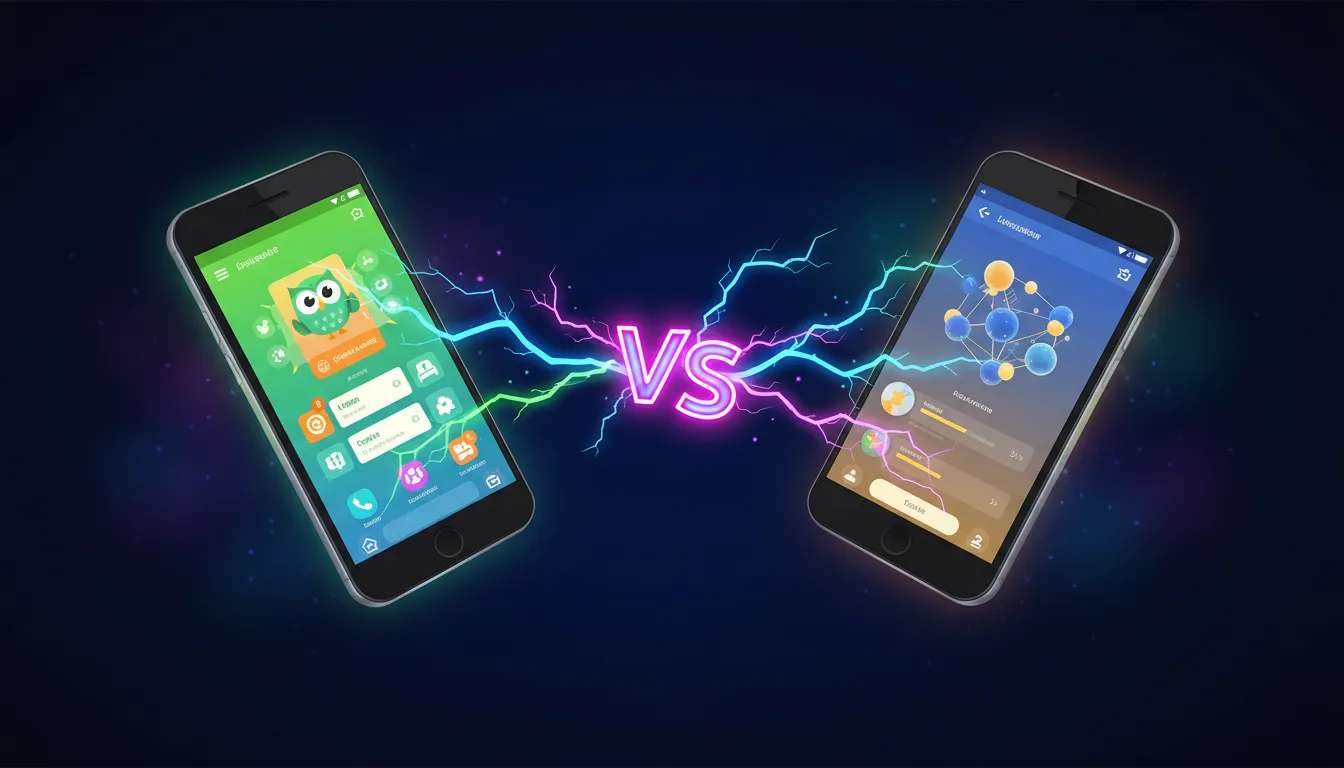
When you search for language learning apps, you'll find Duolingo on every list. But Busuu? It's the app that's been quietly building a different approach since 2008, one that prioritizes CEFR-aligned structure and native speaker feedback over streaks and leaderboards.
Both apps use community features, but their philosophies couldn't be more different. Duolingo turns language learning into a game you play alone (mostly). Busuu tries to connect you with native speakers who correct your writing. One gets you addicted to points. The other promises real structure and human feedback.
So which one actually helps you speak a language? Let's break down what each app does well, where they fall short, and whether either can replace a real conversation.
Quick Comparison
| Feature | Duolingo | Busuu |
|---|---|---|
| Price | Free (ads), $13/month Premium | Free (limited), $10/month Premium |
| Gamification | Heavy (streaks, XP, leagues) | Light (study plan progress) |
| Curriculum Structure | Unit-based, loosely defined | CEFR-aligned (A1-B2 levels) |
| Native Speaker Feedback | None | Yes (community corrections) |
| Speaking Practice | Speech recognition only | Speech recognition + community |
| Certification | Duolingo English Test (separate) | McGraw-Hill partnership |
| Course Quality | Varies wildly by language | More consistent, fewer languages |
| Best For | Daily habit formation | Structured learners who want feedback |
Duolingo: The Gamification Giant
Duolingo has 500+ million downloads and became a verb ("I Duolingo'd for 10 minutes"). It's free, it's everywhere, and it's designed to keep you coming back.
What Duolingo Does Well
The streak system works. That green owl guilt-tripping you at 11:58 PM? Annoying, but effective. Duolingo's entire interface is built around daily engagement. You earn XP, unlock achievements, compete in leagues, and watch your streak number climb. For people who struggle with consistency, this gamification creates a genuine habit loop.
The barrier to entry is zero. No textbook. No signup friction. No "which course should I take?" You pick a language, tap Start, and you're learning within 30 seconds. That simplicity is Duolingo's superpower.
It covers an absurd number of languages. Spanish to Swahili to High Valyrian (yes, really). If you want to learn a less common language, Duolingo might be your only app option. The quality varies dramatically, but the breadth is unmatched.
The audio is high quality. Professional voice actors, clear pronunciation, variable speeds. The listening exercises are genuinely useful for training your ear.
Where Duolingo Falls Short
No real curriculum. Duolingo's "units" are organized around themes (Food, Travel, Family), not linguistic complexity or grammar progression. You might learn "The elephant drinks milk" before "I am hungry." There's no clear path from A1 to B2. You're just... doing exercises.
Zero speaking practice. The speech recognition detects if you said words, not if you said them correctly in context. There's no conversation simulation, no back-and-forth, no "what would you say if..." scenarios. You're repeating scripted sentences into your phone.
Translation exercises dominate. Most lessons are "translate this sentence." That's useful for recognition, but it doesn't teach you to think in the language. You're always mentally converting, never just speaking.
The community features are an afterthought. Duolingo has forums and a social feed, but they're buried. The app doesn't facilitate practice conversations or peer feedback. You're learning alone.
Progress is measured in points, not proficiency. You can have a 365-day streak and still freeze when someone asks you "¿Cómo estás?" The app rewards showing up, not learning.
If you want to compare Duolingo to other major apps, check out our detailed breakdown in Duolingo vs Babbel vs Rosetta Stone.
Busuu: The CEFR-Aligned Alternative
Busuu launched in 2008 as a social network for language learners. While Duolingo was building game mechanics, Busuu was partnering with McGraw-Hill and mapping courses to the Common European Framework of Reference (CEFR). It's less popular, but it's more serious.
What Busuu Does Well
The curriculum is structured around actual proficiency levels. Busuu's courses follow CEFR standards: A1 (beginner), A2 (elementary), B1 (intermediate), B2 (upper intermediate). Each level has clear learning objectives. You know what you're working toward.
Native speaker corrections are the killer feature. You complete writing exercises (describe this image, answer this question), and native speakers in the Busuu community review your work and provide corrections. Real humans. Real feedback. It's slow and inconsistent, but when it works, it's incredibly valuable.
Grammar explanations are better. Busuu doesn't just throw sentences at you. Each lesson includes grammar tips, conjugation tables, and explanations. You learn why something works, not just that it works.
McGraw-Hill partnership adds credibility. Busuu offers official certificates aligned with CEFR levels. They're not going to get you a job, but they're more meaningful than a Duolingo streak screenshot.
The study plan feature creates structure. Tell Busuu your goal (conversational fluency in 6 months), and it builds a daily plan with specific lessons and time estimates. It's not AI-powered, but it's more than Duolingo's "just do more lessons."
Community writing exercises force output. You can't passively consume. You have to write sentences, describe photos, respond to prompts. Then you wait for corrections.
Where Busuu Falls Short
Native speaker corrections are unreliable. Sometimes you get thoughtful feedback in 10 minutes. Sometimes you get "good job 👍" after 3 days. Sometimes you get nothing. The quality and speed depend entirely on who's online and feeling helpful.
Limited AI features. While competitors are integrating AI tutors and conversation practice, Busuu's "AI-powered review" is just spaced repetition with a fancy name. There's no conversational AI, no adaptive practice, no personalized content generation.
Fewer language options. Busuu offers 14 languages vs Duolingo's 40+. If you want to learn Korean, you're covered. If you want to learn Swahili, you're out of luck.
The free tier is extremely limited. You get access to A1 content and that's it. To reach A2, you need Premium. Duolingo's free tier is far more generous.
Speech recognition is basic. Like Duolingo, Busuu's speaking exercises just check if you said the words. No conversational context, no adaptive difficulty, no real-time feedback on fluency.
The community features don't scale. The native speaker correction system is brilliant in theory but painful in practice. As Busuu grows, the ratio of learners to correctors gets worse. You're competing for attention.
No conversational practice. Despite the community angle, Busuu doesn't facilitate actual conversations. You're not chatting with native speakers. You're submitting writing homework to strangers.
Head-to-Head: Where They Actually Differ
Learning Philosophy
Duolingo believes in addictive engagement. If you show up every day and do 10 minutes, you'll absorb the language through repetition and gamification. Learning is a habit, not a curriculum.
Busuu believes in structured progression. You move through defined proficiency levels with clear goals. Learning is a curriculum, not a habit.
Community Integration
Duolingo has community features (forums, social feed), but they're peripheral. The core experience is solo practice.
Busuu puts community at the center - native speakers correct your writing, you correct others' work. But the system is slow and inconsistent. In theory, it's better. In practice, it's frustrating.
Speaking Practice
Both apps fail here. Speech recognition that checks pronunciation without conversational context isn't "speaking practice." It's reading aloud.
If you struggle with speaking anxiety or want actual conversation simulation, you need something designed for that. Victor AI builds conversation practice around real-life scenarios with adaptive AI that responds to what you actually say, not just whether you repeated a sentence correctly.
Progress Measurement
Duolingo measures engagement (streaks, XP, league position). You know if you're showing up, not if you're improving.
Busuu measures proficiency (CEFR levels, lesson completion, test scores). You know where you stand on a recognized framework.
Price vs Value
Duolingo's free tier is usable. The Premium version ($13/month) removes ads and adds offline lessons, but the core content is the same.
Busuu's free tier is a trial. You need Premium ($10/month) to access anything beyond A1. But you get more structured content, grammar explanations, and community corrections.
The Gap Both Apps Share
Here's what neither app solves: you can't have a real conversation with either one.
Duolingo teaches you to translate sentences. Busuu teaches you grammar and structure. But when you're standing in a Barcelona market trying to ask about tomatoes, you're not translating or recalling conjugation tables. You're improvising, listening, adapting, responding.
Both apps assume learning is about accumulating knowledge (vocabulary, grammar rules, sentence patterns). But fluency is about applying that knowledge in unpredictable situations. That requires practice with adaptive conversation, not repetitive exercises.
This is where AI-powered conversation apps like Victor AI make sense. You're not repeating scripted sentences or waiting 3 days for a stranger to correct your homework. You're having real-time conversations about real scenarios (ordering food, asking for directions, job interviews), and the AI adapts to your mistakes and skill level.
Traditional apps and AI apps aren't competitors. They're complements. Use Busuu or Duolingo for structure and vocabulary. Use Victor AI for conversation practice and fluency.
Who Should Choose What?
Choose Duolingo if:
- You need habit formation more than curriculum structure
- You want something free and low-commitment
- You're learning a less common language
- You respond well to gamification and daily streaks
- You're a complete beginner and need zero-friction onboarding
Choose Busuu if:
- You want CEFR-aligned structure and clear progression
- You value grammar explanations and learning why things work
- You're willing to pay for Premium from day one
- You want native speaker feedback (and can tolerate inconsistency)
- You need official certification for your learning
Choose Victor AI if:
- You want to actually speak and have conversations
- You have speaking anxiety and need judgment-free practice
- You're tired of repetitive translation exercises
- You need adaptive practice that responds to your mistakes
- You want real-life scenario training (ordering food, interviews, travel)
For most people, the answer isn't "one app." It's a combination. Use Busuu or Duolingo for daily vocabulary and grammar reinforcement. Use Victor AI for conversation practice. Use real-life immersion (tutors, language exchanges, travel) when possible.
If you're serious about fluency, structure matters. But conversation matters more. No app can replace speaking with real people, but AI conversation practice is the closest thing we have to on-demand, judgment-free speaking partners. Learn more about how AI apps compare in our guide to the best AI language learning apps.
The Honest Recommendation
If you've never used a language learning app before, start with Duolingo's free tier. Build the habit. Get comfortable with daily practice. See if you stick with it for 30 days.
If you want structure and you're willing to pay, Busuu is the better choice. The CEFR alignment, grammar explanations, and community corrections are worth the $10/month - if you're disciplined enough to use them.
If you already have vocabulary and grammar basics but freeze when speaking, skip both and go straight to conversation practice. That's where Victor AI and similar AI tools excel. You can't gamify your way to fluency, and you can't wait 3 days for homework corrections when you need to order coffee in Paris tomorrow.
The best app is the one you'll actually use. But the best learning system combines structure (Busuu), habit formation (Duolingo), conversation practice (Victor AI), and real-world immersion. Use all the tools. Don't rely on just one.
Want more comparisons? Check out our breakdown of the best apps to learn Spanish or the best apps to learn French. Or if you're ready to commit to serious progress, try our 60-day language challenge.
Frequently Asked Questions
Is Busuu better than Duolingo for serious learners?
Yes, if you're willing to pay for Premium. Busuu's CEFR-aligned curriculum and grammar explanations provide actual structure, while Duolingo's unit system is more scattered. Busuu also offers native speaker corrections, which Duolingo doesn't have at all. But Duolingo's free tier is more usable, and its gamification keeps casual learners engaged. For serious learners who want measurable progress toward proficiency levels, Busuu is the better choice.
Can you actually learn a language with Busuu or Duolingo?
You can build vocabulary and basic grammar understanding with both apps. But "learning a language" means different things to different people. If your goal is to read menus and recognize common phrases, yes. If your goal is to have fluid conversations with native speakers, no. Both apps lack real conversational practice. You'll need to supplement with speaking practice (AI tools like Victor AI, tutors, or language exchanges) and real-world immersion.
Is the native speaker feedback on Busuu worth it?
Sometimes. When you get detailed corrections from an engaged native speaker, it's incredibly valuable. But the system is inconsistent. Some of your submissions get thoughtful feedback in minutes. Others get generic "looks good" responses after days. And some never get reviewed at all. It's better than nothing, but don't expect reliable, high-quality feedback on every exercise.
Which app is better for Spanish learners specifically?
For Spanish, both apps have well-developed courses. Duolingo's Spanish course is one of its most mature, with extensive content and audio. Busuu's Spanish course follows CEFR levels (A1-B2) with structured grammar. If you want free and gamified, choose Duolingo. If you want structured and paid, choose Busuu. If you want conversation practice, add Victor AI. See our detailed comparison in best apps to learn Spanish.
Can I use Busuu offline like Duolingo?
Yes, but only with Premium. Busuu Premium lets you download lessons for offline use. Duolingo offers offline lessons in its free tier (with ads) and Premium tier. If offline access is critical and you don't want to pay, Duolingo is the better option.
How long does it take to complete a Busuu course?
Busuu estimates 22 hours of study to complete each CEFR level (A1, A2, B1, B2). So if you study 30 minutes per day, you're looking at about 44 days per level, or roughly 6 months to go from zero to B2. That's faster than Duolingo's vague "complete the tree" progression, but it assumes you're actively studying, not just collecting points.
Does Duolingo or Busuu help with speaking anxiety?
Neither app directly addresses speaking anxiety. Duolingo's speech recognition is just pronunciation checking. Busuu's community features are writing-focused. If speaking anxiety is your main blocker, you need judgment-free conversation practice in realistic scenarios. That's exactly what we built Victor AI for - check out our post on speaking anxiety and practicing without embarrassment.
Ready to Start Your Language Journey?
Join 100,000+ learners using Victor AI to become conversational.
Download Victor AI Free